|
|
|
Instrument |
12.5" RCOS @
~f/9 (2880 mm fl) 0.64 arcsec / pixel. The Zoomify image scale
is 0.85 to 3.07 arcsec / pixel. |
|
Mount |
Paramount ME |
|
Camera |
SBIG STL-11000 w/ internal filter wheel, AstroDon Gen I Filters |
|
Acquisition Data |
11/29/2010 to 12/13/2010 Chino Valley, AZ... with CCDAutoPilot3
& CCDSoft. AOL guided |
|
Exposure |
Lum (no filter)
690 min (46 x 15 min, bin 1x1)
RGB
315 min ( 7 x 15 min each, bin 2x2) |
|
Software |
-
CCDSoft, CCDStack,
PixInsight, Photoshop CS6.
-
No SDSS stars were available for color
balancing, so a standard image-train color calibration was used, as
determined by
eXcalibrator and then adjusted for altitude extinction.
-
PixFix32 (pre-beta) to
repair column defects & pixels.
-
CCDStack to calibrate,
register, normalize, data reject and combine the sub exposures.
-
PixInsight for the RGB combine,
gradient removal and initial non-linear stretching.
-
PhotoShop for the LRGB
combine & final touch-up.
-
Noiseware Pro, a PhotoShop plug-in.
|
|
Comment |
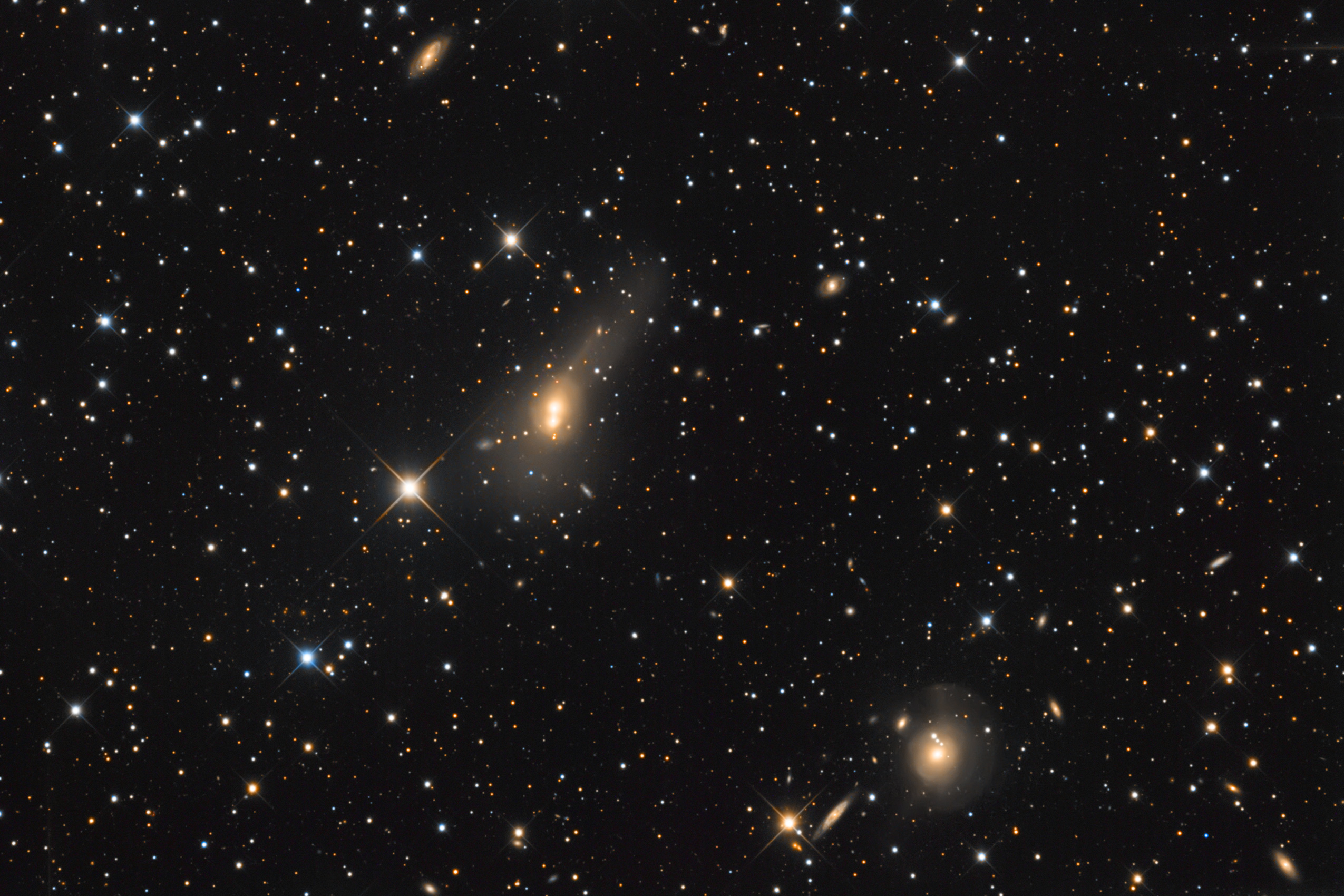
North is to the top.
Arp 166 is composed of
two merging elliptical galaxies, NGC 750 and, the lower, NGC 751.
The visible bridge, between the two galaxies, is clear evidence of
the merging process. Although Arp 166 is two galaxies, its popular
name is The Dumbell Galaxy. Apr166 is located in the constellation
Triangulum, at a distance of about 225 million light-years, and was
discovered by William Herchel in 1784.
At the lower right, is the elliptical galaxy NGC 736. William
Herchel also discovered NGC 736 in 1784. The galaxy is about
200 million light-years from Earth.
|
|