Focal Pointe Observatory
Astrophotography by Bob Franke

Home
Recent Images
Galaxies
Nebulae
   Natural Color
   Narrow Band
   H-Alpha
Clusters
Comets
Solar System
Observatory
Equipment
Tips & Tricks
Published Images
My Freeware
Local Weather
Terrestrial


Send Email

How Galactic Extinction Effects The Color Of IC 342

Image 1


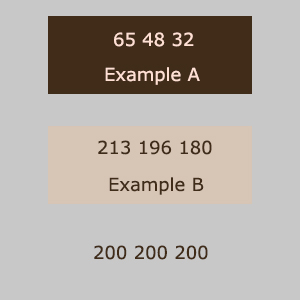
In image one, let's say the white background represents the bright core of a nearby spiral galaxy, located far from our galactic plane. In this position, our view is basically unobstructed and there is virtually no color shift.

The top color bar shows what happens to the white light when the galactic extinction for IC 342 is added. The most effected, blue light, is reduced by magnitude 2.4 or down to 11%. The extinction of the RGB colors changes the white core to a dark brown.


The below table shows the NED foreground extinction data for IC 342. We can see that the blue is reduced by magnitude 2.4, the green 1.85 and the red by 1.49.

Bandpass

B

V

R

Wavelength  [um] 0.440 0.540 0.650
A_lambda [mag] 2.40 1.85 1.49


This makes it easy to calculate the RGB correction factors.

Red = 2.512(-1.49) = 0.253

Green = 2.512(-1.85) = 0.182

Blue = 2.512(-2.4) = 0.110


Obviously, first color bar does not reflect what we see in the sky. If a magnitude zero star is reduced to 2.4, it is still bright and easy to see. However, the RGB intensity shifts show what happens in image processing.

As the image is stretched, the color of IC 342's core changes to the color second bar and finally the third. Galaxy cores are often stretched until one of the RGB colors nears saturation. In the third color bar, this is true with the red channel.  The resulting color is very similar to what we often see in images of IC 342.

The color change, in bars two and three, is the result of adjusting the brightness, with PhotoShop. It is interesting to note that the three color channels were not increased evenly. In the third bar, the red was increased by a factor of 3.85, the green by 5.06 and the blue, 6.39.


Image 2


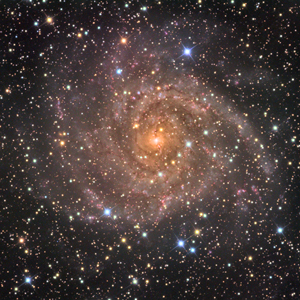
Using G2V stars, or in this case eXcalibrator, the color in image 2 was adjusted using white foreground stars. These nearby stars are not affected by extinction. This results in an image with correct star colors and the galaxy shown in its apparent color, as modified by the galactic extinction.

The color of the galaxy core is similar to the third bar in image 1.


Image 3


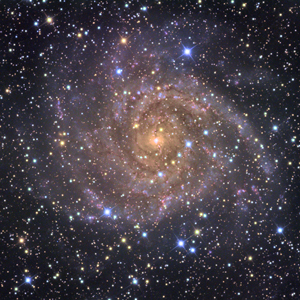
In image 3, the eXcalibrator RGB factors were adjusted for removing the galactic extinction. The color of the outer arms is obviously too blue and, of course, the foreground stars have the same problem.

However, the galaxy core has returned to a shade of pure white.